Community Finds: Michael’s Discovery — A Never-Before-Seen “Old Spring Brook” 12-Year-Old Prohibition Consolidation Pint
Every so often, a bottle surfaces that leaves even seasoned whiskey historians scrambling through the archives. Reader Michael has shared a massive discovery: an unrecorded, immaculate example of Old Spring Brook Kentucky Whiskey, preserved inside an incredibly unique proprietary bottle.
This isn’t just a standard medicinal pint from the dry era. It is a textbook example of a “consolidation bottling”—a physical artifact from the frantic period when the United States government forced independent distilleries to surrender their aging stocks to central hubs.
The Consolidation Act & The Security Warehouse Connection
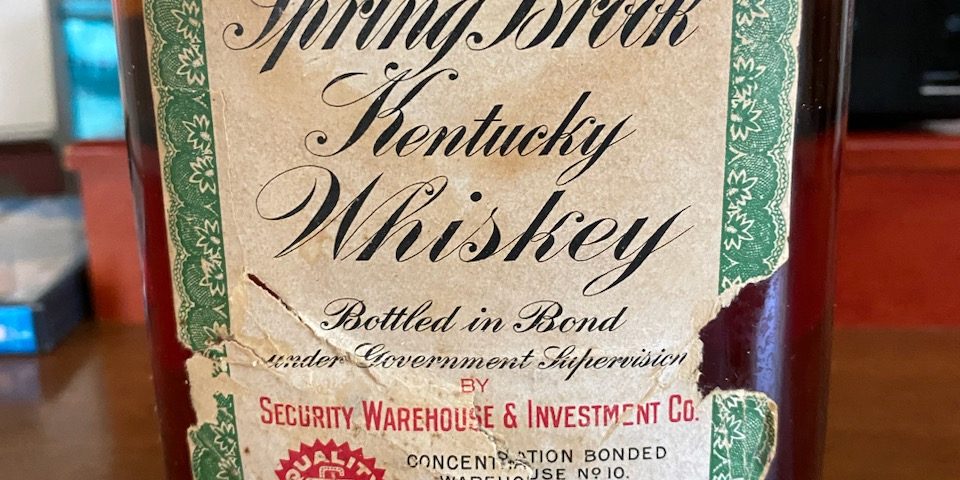
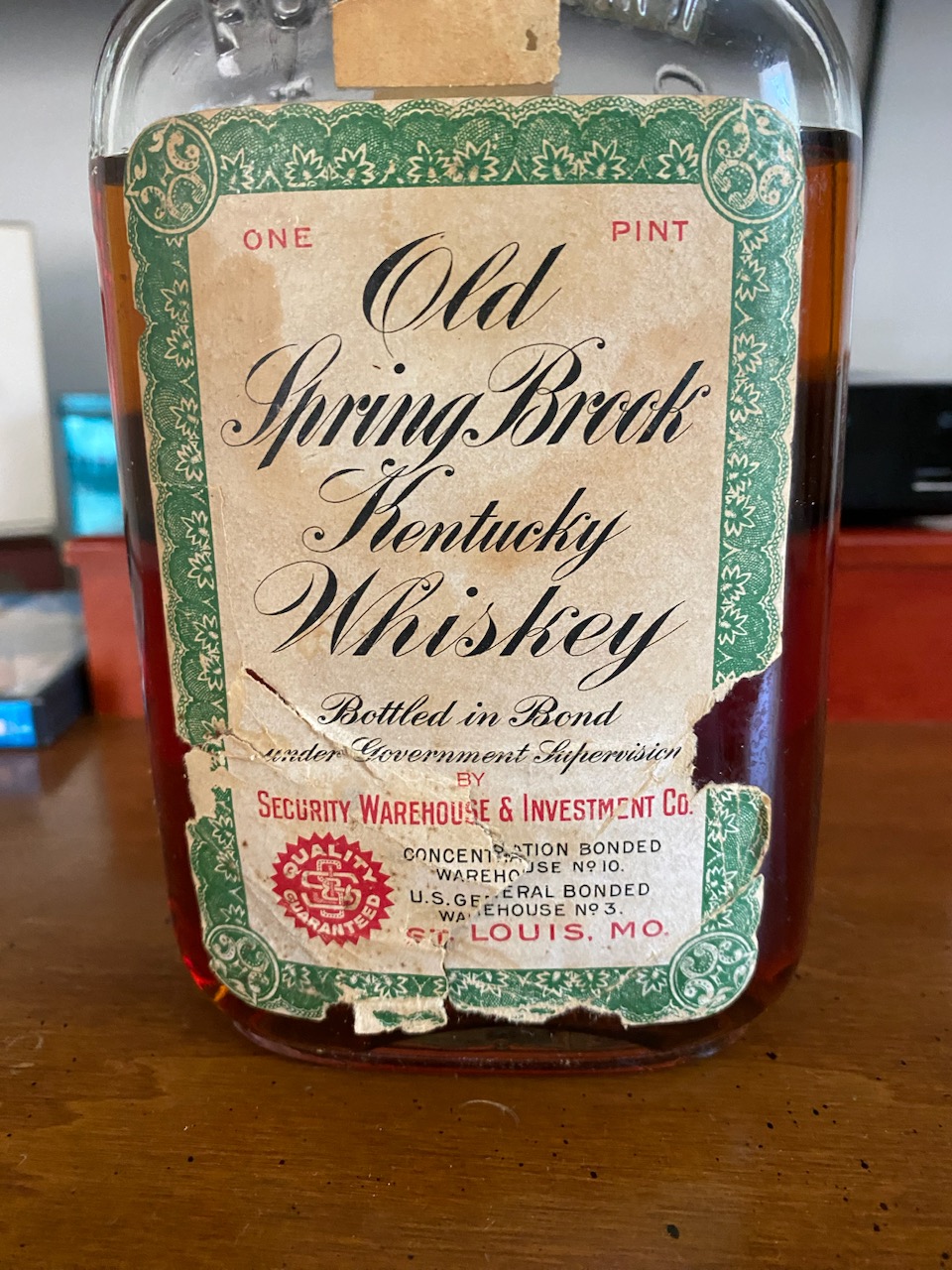
To understand the story on display, you have to look at the prominent red lettering at the bottom of the main label: “Security Warehouse & Investment Co. St. Louis, Mo.”
When Prohibition took effect in 1920, thousands of barrels of whiskey were scattered across hundreds of small, rural distillery warehouses nationwide. The federal government quickly realized it couldn’t properly police all these isolated locations against bootleggers. To solve this, Congress passed the Concentration Act of 1922, designating a handful of high-security, government-supervised facilities as official consolidation hubs.
The Security Warehouse & Investment Company in St. Louis was chosen as Concentration Bonded Warehouse No. 10 (and U.S. General Bonded Warehouse No. 3). Distillers from Kentucky, Illinois, and Missouri were forced to ship their remaining barrels to this massive St. Louis facility. The warehouse company took over the distribution and eventual bottling of these “orphan” barrels under whatever brand names they could legally secure.
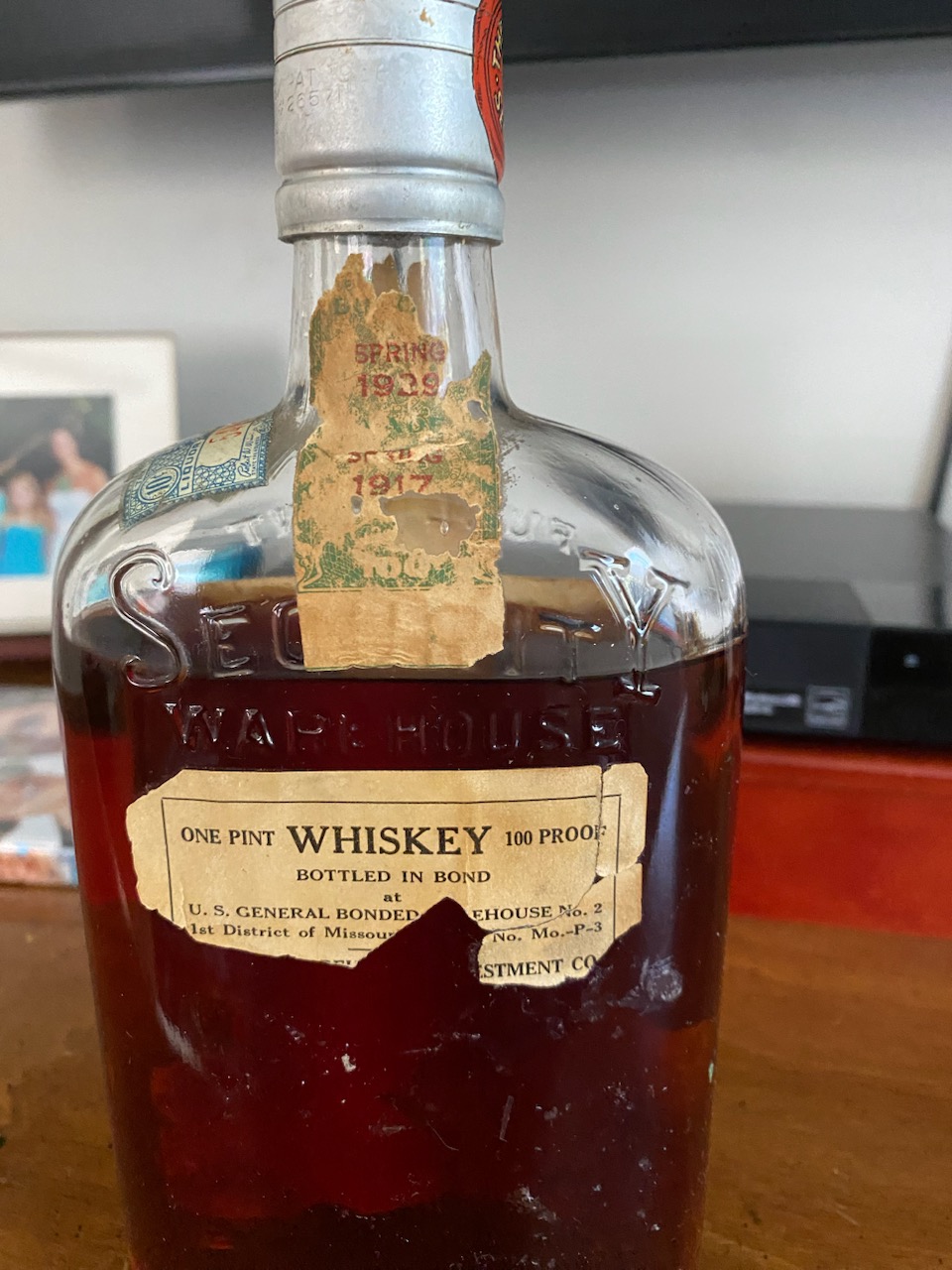
Decoding the 22-Year Maturation
The green Bottled-in-Bond federal tax strip in reveals an absolutely staggering maturation timeline that is almost unheard of for the era:
-
The Distillation: The bottom of the torn tax strip reads “SPRING 1917.” This tells us the whiskey was distilled right before the Food and Fuel Control Act effectively halted commercial distilling for World War I.
-
The Bottling: The top of the strip reads “SPRING 1929.”
-
The Age Statement: Because it was distilled in 1917 and locked away in wood until 1929, this Kentucky spirit aged for an incredible 12 years in the barrel.
Reading the Glass and Paper
Michael’s photos show incredible technical details that make this a museum-grade piece:
-
The Proprietary Glass: On this example, you can see heavy, raised embossing blown directly into the back shoulder of the glass: “SECURITY WAREHOUSE.” The company went so far as to order custom, branded glass flasks specifically for their consolidation operations.
-
The Blue State Tax Stamp: On the left shoulder, a blue, rectangular state liquor tax stamp is still affixed. This indicates that while the whiskey was distilled and aged during the dry era, it was ultimately sold legally on retail shelves after the country went wet following Repeal.
-
The Seal: The metal screw cap and tax strip are completely unbroken, resulting in a pristine, high-shoulder fill line with zero notable evaporation over nearly nine decades.
Finding an completely undocumented brand like Old Spring Brook with a 12-year age statement, custom branded glass, and full consolidation labeling is as historic as it gets.
A monumental thank you to Michael for sharing this absolute masterpiece with the community!
Have a mysterious bottle from the archives hiding in a cellar?
Whether it’s an unrecorded pre-Prohibition brand, a rare consolidation pint, or a vintage post-Repeal find, we want to help you unpack its history. Head over to our updated Whiskey Bottle Evaluation Form to send over your photos!